Species Guide
Birch vs. Aspen: How to Tell These Lookalike Trees Apart
Two pale trunks stand a few feet apart at the edge of a clearing, and at a glance they could be the same tree. One is paper birch, the other quaking aspen. Look closer and the differences start stacking up: how the bark breaks, how the leaves hang, whether the tree stands alone or arrives in a crowd, and what part of the continent you're standing in. Once you know the four things to check, the identification takes about ten seconds.
Start With the Bark
Bark is the fastest clue, but only if you read it carefully. Both trees have smooth pale bark with lenticels — the horizontal dashes that let a trunk breathe — and that shared feature is exactly what trips people up.
Birch bark
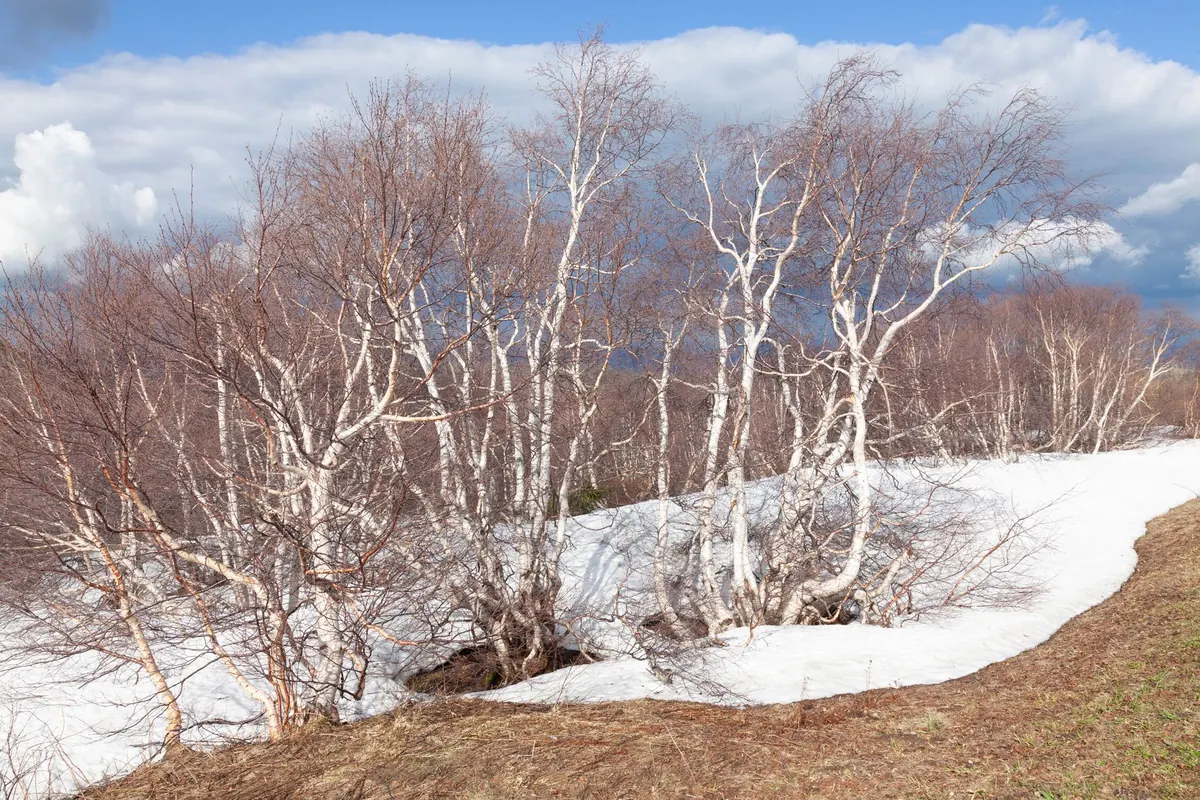
Paper birch (Betula papyrifera) has white to cream bark that peels away in thin, papery strips, usually curling horizontally around the trunk. Peel a loose strip and you'll find the lenticels continue onto the undersides, and the exposed layer beneath is lighter and slightly satiny. Where a large branch meets the trunk, look for a dark, chevron-shaped scar — a near-guarantee you're looking at a birch.
Other birches show the same family trait in different colors. Gray birch is chalky white with dark triangular patches below the branches, and it barely peels. River birch shrugs off shaggy, salmon-brown curls. As birches age, the base often turns rough and gray-brown while the upper trunk stays bright.
Aspen bark
Quaking aspen has smooth bark with a faint green cast, because chlorophyll sits in the living bark and actually photosynthesizes. Its lenticels read as dark eye-shaped bands, and old branch scars look like black eyes or knots. What it does not do is peel in sheets. Instead, a mature aspen slowly roughens: the lower trunk develops deep dark furrows and a battered-looking base while the upper trunk stays pale. A big aspen can look like two different trees stacked on top of each other.
Rule of thumb: if the trunk is shedding papery strips you can write on, you're holding birch bark. If it's smooth, greenish, and stubbornly attached, think aspen.
Read the Leaves
Both trees carry simple, alternate leaves with toothed edges, so the detail is in the shape and the stalk.
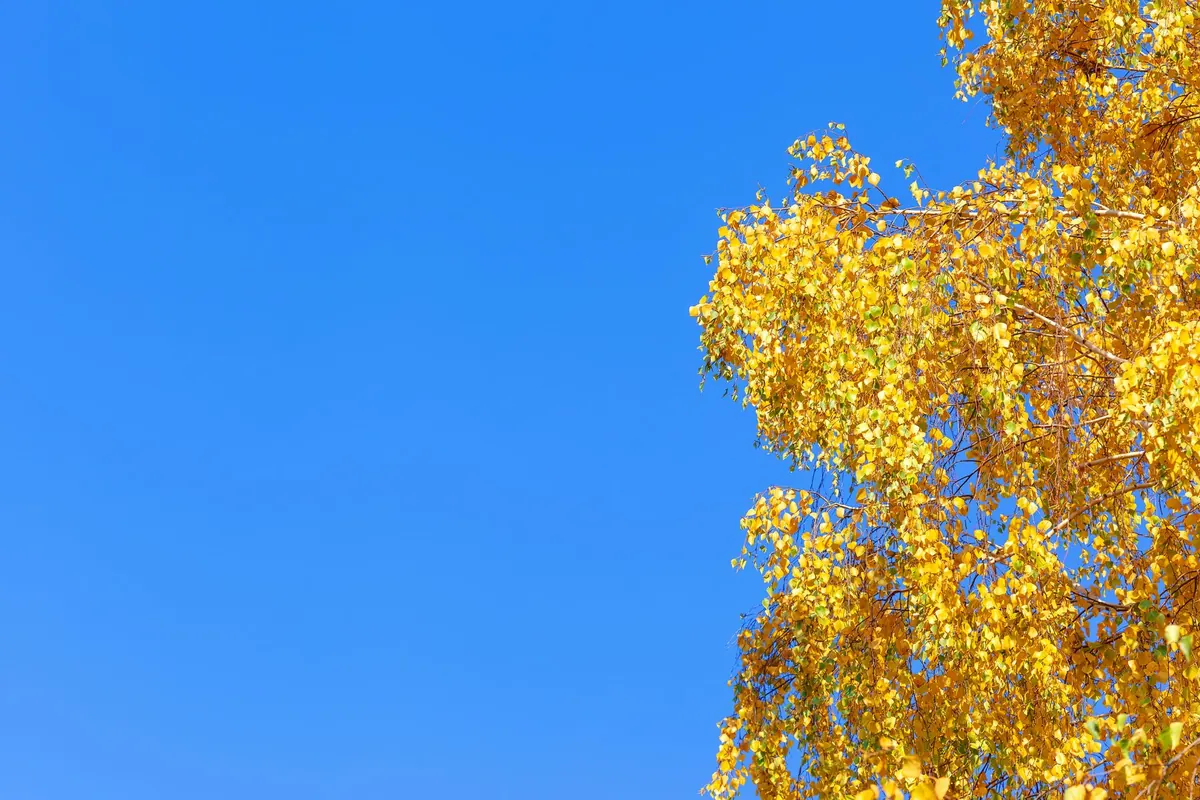
Birch leaves are oval to egg-shaped with a pointed tip and a rounded or slightly heart-shaped base. The margins are doubly serrated — teeth with smaller teeth on them, which gives the edge a ragged, saw-toothed look. Paper birch leaves run roughly 2 to 4 inches, matte green above and lighter below, and they turn clear yellow in fall.
Quaking aspen leaves are nearly round or triangular, usually smaller, with fine, even, curved teeth. The giveaway is the stalk: it's flattened along its length and set at right angles to the blade. That hinge is what lets the leaf twist and shudder in the faintest breeze, making the whole tree shimmer. Bigtooth aspen is the exception in its own genus — larger leaves with coarse, blunt teeth, gray-green underneath.
Hold a leaf flat on your palm. If the stalk looks like a ribbon and the blade rocks side to side, it's aspen. If the stalk is round and the edges look double-cut, it's birch.
Watch How They Grow
Growth habit separates them at a distance. Birches often grow in clumps of two, three, or more trunks rising from one base, with slender branches sweeping upward and a light, airy crown. Single-trunk birches in the open form a narrow oval head. They spread mainly by seed, though cut stumps will sometimes sprout.
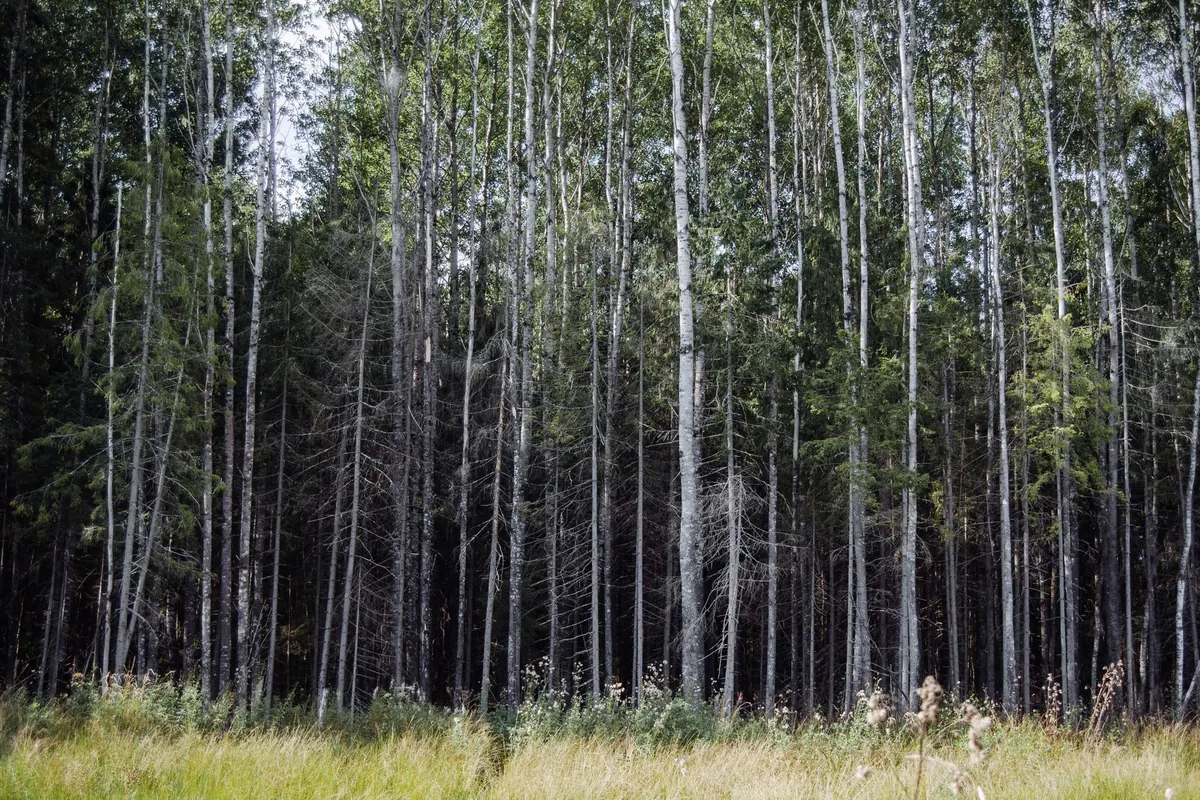
Aspen is a colony tree. It sends up suckers from shallow roots, so a stand is frequently a single clone — genetically identical trunks, straight as fence posts, all leafing out and turning gold within days of each other. A clone can cover acres and persist for a very long time, regenerating after fire or logging. If you see dozens of even-aged, evenly spaced pale trunks that move together through the seasons, you're likely inside one aspen clone.
Check Where You're Standing
Range narrows the options before you even touch a trunk.
- Paper birch: boreal and northern forests from Alaska across Canada and into the northern United States, plus higher elevations in the Rockies and Appalachians. It favors cool, moist, well-drained ground — lake shores, rocky slopes, and burned-over sites.
- Quaking aspen: the widest natural range of any North American tree, from Alaska to Newfoundland and south into the mountains of Mexico. It tolerates poorer, drier, rockier soils and is a classic first tree back after a fire.
- Bigtooth aspen: mostly the eastern United States and adjacent Canada.
- Europe: silver and downy birch fill the birch role, while European aspen (Populus tremula) does the quaking.
In the northern forest the two overlap constantly, so range rules out little on its own. Fall back on bark and leaves.
Seasonal Clues That Settle It
In late spring, aspen releases seeds wrapped in cottony fluff that drifts like snow — it belongs to the same genus as cottonwood, and it shows. Birch does the opposite: its seeds form in cone-like clusters called strobiles that ripen in late summer and break apart through fall and winter, leaving small brown cones hanging on the twigs when everything else is bare.
Winter identification is still doable. Aspen buds are pointed, slightly resinous, and aromatic when crushed. Birch twigs are finer, with small buds and often visible catkins. And in fall, look at the color pattern: an aspen clone flips to gold almost in unison, while birch turns yellow tree by tree.
A Four-Step Field Check
- Peel test: does a loose strip come away like paper? Birch.
- Leaf test: round blade on a flattened stalk that quivers? Aspen. Oval blade with double teeth on a round stalk? Birch.
- Trunk test: tight greenish bark with dark eye-shaped scars and a furrowed base, no peeling? Aspen.
- Group test: many straight trunks moving through the seasons together? Aspen clone. A loose clump of leaning, peeling trunks? Birch.
Practical Takeaways
Don't peel bark from living trees to test them — that wound is an open door for disease and insects, and it removes the layer that shades the trunk. Learn to identify by leaf, bud, and scar instead, and practice on trees you already know before you try the tricky ones.
If you need to know for certain — a removal, a tree that's declining, a planting plan for a wet corner or a dry slope — a certified arborist or your regional extension office can confirm the species and tell you what it needs in your specific soil and climate. Birch and aspen look alike, but they want different conditions, and choosing the wrong one costs you a tree.
Photo: Plato Terentev / Pexels